1979
Sam and Simon in Cahoots. Jim in Ever After, then on a national tour with Nutshell.
1980
Sam and Simon in The Buskin’ Band. Jim moves to London, then Manchester.
1981
Ken’s work in The Nethrbow Restaurant leads him to buy a Tea Room in Rothbury Northumberland and becomes Egon Ronay Recommended in the ‘Just a Bite Guide’. He assists with the running of Linden Folk with Tony Welbrock, Rod Clements of Lindisfarne and Geoff Heslop of Black Crow records.
1982
Sam and Simon in ‘The Wilde Cigarillos’ and ‘The Fairly Solid Theatre Co.’
1983
Ken sets up ‘Pineapple Agogo’ carnival and dance band with Dodgy Clutch Theatre Co. www.dodgyclutch.com. Albums ‘Big in Winnipeg’ and ‘No Tripe Por Favor’ follow. Jim goes out to Harare, Zimbabwe, teaching English.
1984
Jim returns from Zimbabwe, settles down and gets a real job; discovers computers.
1986
Simon works on a youth project in Botswana and records an album in the Kalahari Desert with Duncan Senyatso and the Kgwape Band playing his own brand of highlife mandolin.
1987
Jim gives up the day job and forms Bernie Hot Hot with David Dunne and Pete Condor.
1988
Ken forms the Heaton People’s Band bringing the first steel pans set to the North East of England. The People soon choose to be called The 10th Avenue Band. www.tenthavenueband.co.uk.
1990
Jim forms Reel Funk Inc with Pete Condor and Shairon Rodgers.
1992
Kissing Spell shows an interest in releasing the 1978 album as a CD.
1993
Simon records ‘Private’ with Dave Heavenor as ‘The Night Visitors’. www.davidheavenor.com.
1994
Kissing Spell releases CD of ‘Caedmon’.
1996
Ken forms The Newcastle All Stars Steel Orchestra an 18 piece teenage band. www.newcastleallstars.org.uk
1998
Simon and Sam form Flaming Nora Ceilidh Band. www.flamingnora.org.uk
2000
Ken coordinates ‘Making Music On the Line’ with Folkworks, Channel 4 and Oxfam. A band of ten musicians from Shetland, Northumberland, Gascony, Catalonia and Burkina Faso perform on a year long project in each of their countries. (Catriona Macdonald, Alison , Sandra Kerr, David Oliver, Pierre Schidt and Les Sous Fifres, Cati Plana, Francina Turon, Salif Ouedrago and Mama Kouyate).
Jim forms the Jazzrascals with Peter Condor, a studio based band who publish their music on the web: www.jazzrascals.com
2001
Ken works with Richard Scott (Grand Union) in Rich Pickings and 4 Corners Music Network. 4cornersmusic.com. The network includes Yousuf Ali Khan, Gerry Hunt, Graham Raine, Cheng Yu and Zed Morgan.
2002
Kissing Spell releases a Caedmon Live CD.
Ken acts with Theatre Sans Frontieres in ‘Le Tour de France’ in a national tour. He starts a relationship with the company composing and music directing. www.tsf.org.uk
2003
Ken composes ‘Tyne Times’ for a Tyneside International Streetband Festival. A massed band of 100 musicians (Germany, France, Netherlands, UK and USA) plays the piece by the Millennium Bridge in Gateshead.
2004
Ken acts in ‘Round the World in 80 Minutes’ a further collaboration with TSF, filmed in Cameroon, Tunisia, Belgium, Switzerland and Quebec for a multi media theatrical show.
Jim sets up the ‘James Bisset: Fiftieth Anniversary Edition’ project.
2006
Ken composes music for TSF’s ‘La Pelota Magica’.
2007
Ken composes music for TSF’s ‘Les Contes Dores”.
May 2008
Jim, Ken, Sam and Simon meet for 3 days of jamming to develop an album of new material in Weardale, England.
Oct 2008
Jim, Ken, Sam and Simon back to Weardale to record over two weekends in October, working up some of the material started in May
Nov 2008
Ken and Simon go to Walsall, England, and record Angela’s vocals on four tracks
Feb 2009
Jim, Sam and SImon work on the mix in Edinburgh, Scotland.
July 2009
The band meet in Weardale, jam and decide to record with a producer and released completed demos on this website only
November 2009
The band meet in Weardale to write / perfect 12 tracks for the future album
January 2010
The band meet in Weardale to write / perfect 12 tracks for the future album
March 2010
Whole band rehearses stage set in Weardale Primary School for weekend
25th April – 2nd May 2010
Jim, Ken, Sam and Simon record at Durisdeer with Steve Butler
7th & 8th May 2010
Two nights of Caedmon in concert at The Scottish Story Telling Centre Edinburgh
Angela records vocals for album in Simon’s attic.
July 2010
Jim, Ken, Sam and Simon record at Durisdeer with Steve Butler, Steve continues to mix over next few weeks.
Oct 2010
One day of final mixing with Simon, Ken and Steve.
Dec 2010
‘A Chicken to Hug’ is released on iTunes, Amazon, Spotify and as a digipak CD.
2015
Simon and Sam in davesnewbike release ‘wanderlust‘ cd album with Tom Houston and Kris Jozajtis
2016
Friend Peter Ryder challenges Caedmon to write a version of the ‘Dream of the Rood’. They meet up, write and record in Newcastle and Edinburgh and release a demo version on Soundcloud.
2017
Simon and Sam in davesnewbike release ‘The Tin Can and the Flood‘ cd album with Tom Houston and Kris Jozajtis
2019
The whole band meets and makes series of documentary videos with locations around Edinburgh. They work on ‘Runaway’ for the album that is to become ‘RARE’.
They meet a few times to write and record in Edinburgh. Simon and Dave Heavenor look through old 1/4″ tapes from the ’70s and the they are taken to be digitised.
2019
Guerssen Records approach Caedmon for permission to release a vinyl version of the 1978 album (including a 7″ single special INSET and limited edition gold vinyl albums) and Jim remasters from the original 1/4″ master.
2020
New album ‘RARE’ is completed and is released on vinyl and as a CD. Caroline Brown (Simon’s wife) and Sally Jaquet (Simon’s daughter) both contribute with vocals on some of the new tracks.
The 1978 album is available on streaming services for first time as well as the Guerssen rerelease.
2020
Simon and Sam in davesnewbike release ‘Smiling at the Croft’ cd album with Tom Houston and Kris Jozajtis.
2020
Ken creates an animated cartoon version of ‘Sea Song’.
The band meets up and starts on demos four new songs before COVID 19 scupper their plans.
Acid Folk, Prog Folk Rock, Psychedelic Folk, Wyrd Folk are all used on widespread websites to describe Caedmon’s music.
Classification genres are surely made up by collectors and not by musicians. But it is interesting that clear criteria can be worked up.
Here’s some definitions summarised from psychedelicfolk.homestead.com. I suspect that they’ve all been coined some time after the heyday of the folk rock revival of 1965 – 1980.
Acid Folk: acoustic music that doesn’t reproduce or start from traditional elements…a reinvention of folk, producing a mind-freeing experience.
Folk Rock: typified by Fairport Convention and Steeleye Span… a combination of folk and rock based upon traditional tunes, Folk Music with some electric guitars and drums.
Psychedelic Folk Music : “psychedelic” as a musical genre is often associated with “mindexpanding experiences”, which are absolutely not necessarilly drugs-experiences. There are musical effects used, to express such an experience. In acoustic music, this could mean a somewhat open tuning and freedom for jamming improvisation, there are casual eastern influences.
Progressive Folk : when the “progressive” elements are very well worked out in instrumentation, but the basic use of acoustic instruments is still important.
Wyrd Folk: it’s something like acoustic music with an open, intuitive idea, acid folk music with purity, honesty, etc. without that it necessarily has to be psychedelic or completely free.
Caedmon’s music does, in some way, match up to all these different classifications. They never met Stone Angel, Mellow Candle, Comus and the other names which nestle together in histories of Acid Folk and so on. To be honest I’m only just starting to listen to them now, after thirty years.
So, bands that never knew each other, where there was no ‘cross pollination’ in performance or otherwise, can now be parcelled together. Listeners have found similar sounding bands through ‘wishlist’ culture: an ‘if you like this….. then you’ll like this’ approach. The commonalties no doubt arise as a result of the fusion of influences heard at the time of music making, the sounds made on vinyl by major bands with recording contracts.
What were the musical influences for Caedmon in the years leading up to 1978?
I followed Pentangle (I saw them playing live in the early seventies three times …. including a show with an all electric guitar line up ….. with Orange combo back line amps). Simon was a Fairport Convention devotee, and I remember being impressed on hearing Sam’s Yes Album for the first time….. Jim played Humble Pie at great volume on Saturday mornings in the band flat progressing to Sly and the Family Stone, Rufus and Funkadellic in the period up to 1978.
Is interest in Caedmon because of their instrumentation?
Current reviews of the Caedmon album dwell upon instrumentation: ‘This scottish outfit released this sole album in 1978, and it is one of the best and rarest psychedelic folk albums of the uk. Tasteful use of cello, acoustic guitars, mandolin, bongos and some wild fuzz assaults’. We used what skills we had (including Simon’s clarinet playing, not featured on the 1978 album) without feeling the need to emulate more conventional instrumentations: e.g. lead guitar, rhythm guitar, bass and kit or a folk line up of fiddle, whistle, guitar and bass, that were in the music we listened to. Angela’s pure voice, Jim’s ‘fuzz guitar’, Simon’s mandolin and songs, Sam’s bass guitar virtuosity, and Ken’s ‘cello…….. make Caedmon ‘Acid’ or ‘Psychedelic.
The lack of drum kit, is surely a key factor in the 70’s Caedmon sound?
Also reviews comment upon layered voices: ‘This is a worthy complement to Fairport or Pentangle, containing some exquisite male and female vocals’….. this again reflected the times we had enjoyed in our teenage years: The Beatles, America, Crosby, Stills and Nash & even The Carpenters were an influence upon vocal arrangements as well as the ear harmony tradition of folk music.
Classification of Caedmon in 1978: Christian Folk Rock
In 1973 – 1978 we saw our music as Christian Folk Rock. We were often described as ‘Gospel Music’ a classification which would now indicate black choral music. The Acid, Prog, Psychedelic and Wyrd tags had not been coined.
The Encyclopedia of Contemporary Christian Music (2002) defines Christian Folk Rock as “music that appeals to self-identified fans of contemporary Christian music on account of a perceived connection to what they regard as Christianity”.
In our approach to writing and arranging new songs, we were post-Beatles in our thinking with an ‘anything goes’ attitude resulting in an eclectic mix of styles. There was, however, a need for us to justify the lyrical content of our songs to the Christian community we served. I remember much debate in the band about whether we were musicians whose faith became evident in writing, or Christians whose prime mission was to ‘spread the word’ through the medium of music. We, as individuals, represented a broad church of Christian views from low church to high, evangelical to conservative, so our make up was complex in more than just musical style.
In parallel with secular musical influences, the lyrical content was affected by similar Christian artists and bands: Parchment, Nutshell, Larry Norman, Randy Stonehill, After the Fire, the bands who were at the forefront of the genre.
But I think it was our peers who performed in Edinburgh at the time who influenced our approach to lyric writing and presentation the most. David Heavenor and Jamie ………. regulars at Charisma, Ricki Ross who played piano and wrote songs with ‘Under the Sun’ in Dundee before his Deacon Blue success, and ‘Miracle Road’ who became ‘Ever After’.
Also we were influenced by those who visited Edinburgh and performed alongside us: e.g. Adrian Snell, then a pianist singer song writer and `The Water into Wine Band’ from Cambridge.
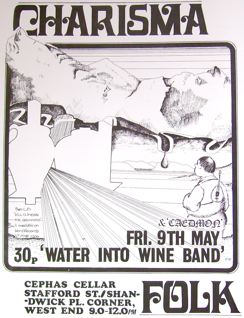
We were over earnest and young, we were naive, but we were original. And if you were the blog reviewer who wrote ‘I mean, come on, what’s with the Caribbean-Celtic tracks?!?’ …… my reply to you is: we were just experimenting with all that was about us and having a good time. There were no rules about genre mix.
Had we known that in 20 years the internet would provide a distribution network for our LP to large numbers of listeners, we would have laughed and gulped and then spent more time recording it. We certainly could have ironed out the slips in intonation and meandering tempos (which we as performers of course listen to most) …… but perhaps some of the freshness would have been lost.
Acid Folk: an anecdote.
In 1977 we played a week of successful late night concerts at the Edinburgh Fringe. We packed up after the last gig, a Saturday night, and set off in our grey Ford Transit for Bedfordshire after midnight. We were hitting the ‘Big Time’, playing at The Greenbelt Festival. We shared driving through the night, noticing that the headlights were gradually dimming: some sort of alternator, dynamo, battery problem. We kept on going, there wasn’t much traffic and we had our important gig to make in only a few hours time.
At 4am we took a ‘comfort break’ in a lay by. A police car pulled up out the gloom. The police seemed convinced that drugs were to be found. We wore denim, had long hair, & were in a beaten up old Transit. In the time that it took him to interrogate us about possible substances, dawn broke and we eventual set off without having to switch on the pitiful lights which, if the officer was trying to make a conviction, were a much better line of enquiry.
The long arm of the law seemed convinced of our classification as ‘folk on Acid’.
We didn’t drink, do drugs or have any psychedelic experiences.
(Does Mac Barren’s Scottish Mixture count? Jim, Ken and friend Lance Stone enjoyed a pipe smoking phase….. a curious and unpopular pastime …… ‘Who’s that smoking custard?’)……..
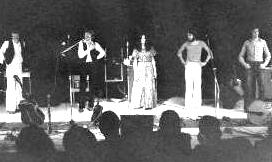
Photos above from left to right:
Jim Bisset – acoustic guitar, electric guitar and vocals
Simon Jaquet – acoustic guitar, mandolin, clarinet, bongos and vocals
Angela Naylor – vocals and recorder
Sam Wilson – acoustic guitar, electric bass and vocals
Ken Patterson – acoustic guitar, keyboards, cello and vocals
In 1978 on Stage
Biographies:
Ken Patterson.
Ken played ‘cello and piano from the age of eight. Both were taught in a very formal led by reading exercises and exams. It was teaching himself with his first guitar at the age of fourteen that opened open the world of chords and harmony to him. He played in various ‘Gospel bands’ at school and developed the ability to accompany by ear. He was initially a vet student at Edinburgh but changed to Biological Sciences after two years of resitting exams. He specialised in Psychology in his honours year.
During Caedmon’s Edinburgh Fringe appearances, he worked in The Netherbow’s restaurant and hatched a plan to work with food. After a 18 months as an underbuyer in Fenwicks of Newcastle he set up shop in Rothbury, Northumberland with ‘The Old Sun Country Kitchen’ a tearoom. After three successful years, and becoming Egon Ronay recommended, he trained as a primary school teacher.
In 1984 he had is first job as a teacher in Newcastle. Music started to lead his career path again in 1991 when he became advisory teacher for primary music in the Newcastle LEA. He introduced steel bands in a large number of schools, and contributed to National Curriculum working parties. Community music became a major strand with Pineapple Agogo, The Heaton Peoples Band / Tenth Avenue Band and various teenage bands.
In 2000 he became a freelance musician working closely with Folkworks, The Sage Gateshead and co-directing ‘4 Corners World Music Network’ with Richard Scott (Grand Union Orchestra).
In 2004 he started acting with Theatre Sans Frontieres, touring nationally, and has written the music for a number of their shows.
Caedmon Appearances
Caedmon played throughout Scotland from 1973 – 1978 including Aberdeen, Dundee, Edinburgh, Glasglow, and Stirling; and in Bedfordshire, Hull, Manchester, and Whitley Bay in England.
CLICK ON
The gigs
‘73 – ‘75 gigs
‘75 – ‘76 gigs
’76 – ’77 gigs
Writing process
Caedmon’s repertoire was initially a pool of songs that we had heard other bands playing.
The later material was mostly written by individuals in the band which were then arranged in rehearsal.
On some occasions the band got together for a weekend or week away and wrote by jamming and pooling ideas: ‘The Storm’ and ‘The Garden’ are examples, tracks which were not so much songs as compositions. It was the era of symphonic rock: Yes, Genesis and others were writing longer pieces.
Caedmon Repertoire
1973 – 1975
-
-
- ‘Said Jesus to The Willow’ Traditional
- ‘Sing Aloud’
- ‘Now the Green Blade Rises’ John Crum 15th Century French Melody
- ‘Born to Die’
- ‘Pack up Your Sorrows’ Richard Farina
- ‘Jesus is Alive Today’
- ‘Guns and War’
- ‘A Song Won’t Stop the World’ Larry Norman
- ‘Holly and the Ivy’ Traditional
- ‘Swing Low’ Traditional
- ‘Death Knot’ Lance Stone / Jaquet
- ‘Standing with Open Hands Before You Lord’
- ‘Get in Line Brother’ Flatt and Scruggs
- ‘I’ll Fly Away’ Traditional
1975 – 1978
-
-
- ‘London Psalm’ Sam Wilson[*]
- ‘Caedmon’s Song’ Ken Patterson
- ‘Columba’s Song’ Jim Bisset
- ‘Tears May Linger’ Simon Jaquet
- ‘We Are Going to the Garden’ Caedmon
- ‘Sea Song’ Simon Jaquet
- ‘Heaven Haven’ Gerard Manley Hopkins / Simon Jaquet
- ‘Flower’ Ken Patterson
- ‘Ivory Tower’ Jim Bisset
- ‘Worlds and Friends’ Ken Patterson and Jim Bisset
- ‘Aslan’ Simon Jaquet
- ‘The Garden’ Caedmon
- ‘Sunchild’ Jim Bisset
- ‘Caedmon’s Hymn’ Translated from original text Caedmon / Bisset
- ‘Maker Man’ Ken Patterson
- ‘Ten Maidens Fair’ Ken Patterson
- ‘Living in The Sunshine’ Jim Bisset
- ‘The Storm’ Caedmon
- ‘Beyond the Second Mile’ Sam Wilson
- ‘Death of a Fox’ Jim Bisset
- ‘Smile upon Your Face’ Simon Jaquet
- ‘Give me Jesus’ traditional spiritual
[*] Footnote from Sam: Since London Psalm appeared on the Caedmon Live album credited to me I’ve always had this guilty feeling that I had to put the credit right but didn’t know how. The words to London Psalm apppeared as a poem in Buzz Magazine sometime in, I’d guess, 1972 or 73. I rapidly forgot who had written it and lost the magazine. I’ve been unable to find the original poet ever since, and so far Google hasn’t helped. We do seem to figure on more compilations than I was aware of – Looking for London Psalm again I found another – search for “psalm” on this page <http://chocoreve.blogspot.com/2005_10_01_archive.html>
The 1978 Original Album:
01. Ten Maidens Fair, Ken Patterson
02. Maker Man, Ken Patterson
03. Death Of A Fox, Jim Bisset
04. Sea Song, Simon Jaquet
05. Aslan, Simon Jaquet
06. Beyond The Second Mile, Sam Wilson
07. Living In The Sunshine, Jim Bisset
08. Storm, Caedmon (the band)
09. Columba’s Song, Jim Bisset
10. Smile On Your Face, Simon Jaquet
11. Caedmon’s Hymn, Caedmon (the poet) & Jim Bisset
12. Give Me Jesus, traditional spiritual
The Studio
The album was recorded in a tiny home studio in Edinburgh – known to aficionados as ‘Barclay Towers’. No idea what kind of technology was involved, save the incessant fiddling with EQ to try and filter out the buzz of a fluorescent light strip over the cooker that was inadvertently left on during one take.
We recorded over two successive Sundays and mixed at a third session. It was four track reel to reel recording ……. live with occasional overdubs.
Instrumentation
For us as musicians, highlights included using a cup and teaspoon to create the latin style percussion on ‘Maker Man’.
For the recording we borrowed Ever After’s Fender Rhodes but still depended upon my own Crumar Compac Piano which had three sounds: piano, clavichord and harpsichord. I bought it for £100 second hand. There was no touch sensitivity, but it seemed very modern at the time. All organ type sounds were played using the piano setting whilst sliding the volume control from 0 (when hitting the key) to the appropriate volume, to avoid the attack at the start of the note.
‘I played an Ibanez classical guitar on Maker Man that was bought in 1969. I sold my ‘Smiley Joe’ banjolele to raise money for the transaction. I’ve recently been buying ukuleles again to use in primary school work in my region!
The cello was a German instrument from around 1890.
The Album Sleeve
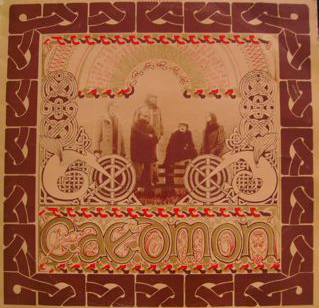
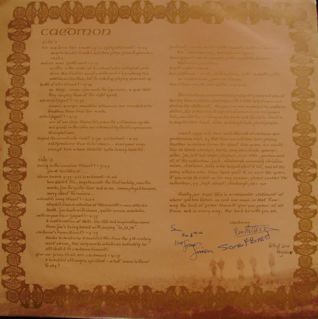
I designed the sleeve with a black Rotring pen on 3 sheets of paper, one for red print, one for brown and one for gold. The Kissing Spell CD replaced gold with green. The buff base colour was intended to be lighter, but inexperience or miscommunication with Blackwoods the printers (famous for The Blackwood’s Edinburgh Magazine, 1817 – 1980) resulted in the colour that collectors now own. I had a few books of celtic designs as well as having an interest in Roger Dean (Yes album covers) and storybook illustration (Arthur Rackham, Mabel Lucie Attwell, Charles Heath Robinson & Bilibin), these influences are more evident on Charisma Folk Club posters from the time.
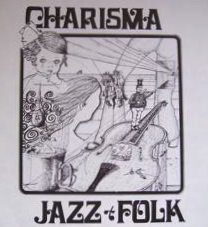
Sam handwrote the sleeve notes and Angela the lyric sheet insert.
The single was included because the intended six tracks per side on a vinyl LP proved impossible to produce and we didn’t want to leave tracks 6 and 12 unreleased’. Ken Patterson.
Ken and Angela first started Caedmon in 1973.
For the next five years, the band played across the UK, changing personnel and vans, and finally playing our farewell concert in Edinburgh in 1978. As a keepsake for ourselves and our fans, we recorded a wee album over a couple of weekends, pressed 500 and sold them at cost price at the farewell concert.
The rest, as they say, is history.
With all the hype and the misinformation that seems to have followed it, we found ourselves obliged to set the record straight. And what better way than our own web site.…
